
イベントを企画するとき, choosing the right LED screen size is critical to ensuring every audience member enjoys a clear, immersive viewing experience. From intimate conference rooms to large-scale auditoriums, the screen’s dimensions and pixel pitch directly impact visibility, engagement, and overall success. Here’s a breakdown of key factors to guide your decision.
1. Understand the Core Rule: Viewing Distance Dictates Design
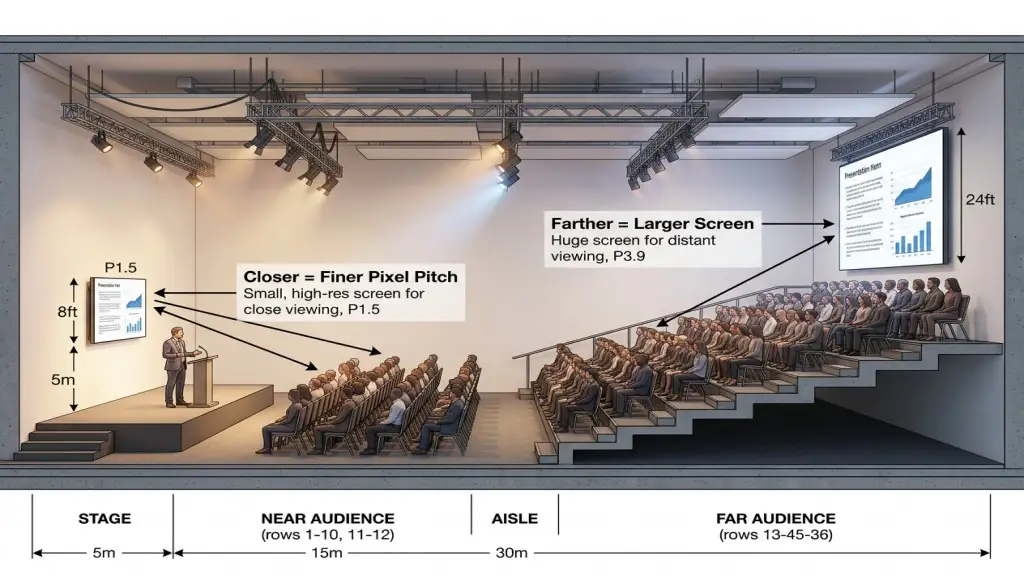
The most fundamental principle of LED screen selection is the relationship between viewing distance and both screen size and pixel pitch. As shown in the venue diagram, closer audiences require finer pixel pitches (like P1.5) for crisp, high-resolution visuals, while distant viewers benefit from larger screens with coarser pitches (like P3.9). This rule ensures no one struggles with blurry text or pixelated images, whether sitting 5 meters or 30 meters from the screen.
2. Match Screen Height to Your Audience’s Seating Layout
Screen height is not arbitrary—it must align with how far your audience will sit. 例えば:
5–10 meters (near seating): Opt for a height of 2–3 meters, ideal for conferences where close attendees need to read detailed slides.
10–20 meters: A 3–5 meter height works well for media events, balancing visibility for mid-range viewers.
20–50 meters: A 5–8 meter height suits large auditoriums or outdoor concerts, ensuring clarity even from the back rows.
50+ meters: Go with 8+ meters for festivals, where distant crowds need maximum visual impact.
3. Prioritize Pixel Pitch for Near vs. Far Audiences
ピクセルピッチ, the distance between individual LEDs, determines image sharpness at different ranges. In the sample venue, the front-of-stage P1.5 screen delivers ultra-clear visuals for speakers and nearby guests, eliminating the “pixel grid” effect common with larger pitches. For the far-audience area, the P3.9 screen is more cost-effective while remaining sharp from 20+ meters. Choosing the right pitch prevents overspending on unnecessary high resolution for distant viewers or underserving close attendees with low-quality displays.
4. Factor in the Venue’s Physical Constraints
Your screen size must fit the venue’s architecture, including ceiling height, wall space, and sightlines. The diagram’s 24-foot (≈7.3m) tall rear screen fits the auditorium’s scale, while the 8-foot (≈2.4m) stage screen aligns with the 5-meter stage depth. Always check for obstructions like lighting trusses or pillars, and ensure the screen’s bottom edge is high enough to be visible to seated guests in tiered seating.
5. Balance Cost and Performance for 2026 イベント
While high-resolution screens offer premium quality, they come with higher costs. 2026 event planners are increasingly balancing performance with budget by using dual-screen setups: a high-pitch screen for near audiences and a larger, standard-pitch screen for distant viewers. This approach, as demonstrated in the sample venue, optimizes both visual quality and cost efficiency, making it a smart choice for modern events of all sizes.
By aligning screen size, pixel pitch, and venue layout with your audience’s viewing needs, you can create a seamless experience that keeps every guest engaged—whether they’re sitting in the front row or the back of the hall.